Summary
Gender Affirming Surgeries 2025 - Exposing the data blind spot: Why anti-trans commentators are getting gender-affirming surgery numbers wrong.
Gender Affirming Surgeries 2025
Exposing the data blind spot: Why anti-trans commentators are getting gender-affirming surgery numbers wrong
Gender-critical voices often assert that many trans people who identify as men or women make little to no effort to pursue medical transition or gender-affirming surgery. However, data from just three NHS Freedom of Information requests paint a very different picture.
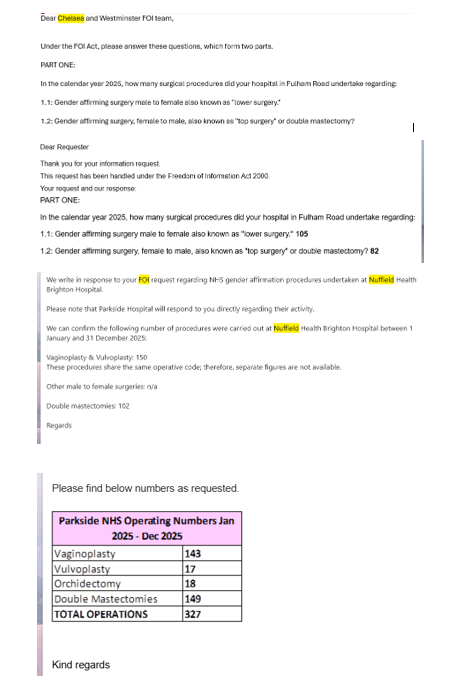
In 2025 alone, there were 433 male-to-female gender-affirming surgeries performed through the NHS, most of which were vaginoplasties.
What exactly is a vaginoplasty?
For trans women, a vaginoplasty is a type of gender-affirming genital surgery. The penis, testicles, and scrotum are removed, and the tissue is reshaped to create a vaginal canal and a vulva, including labia. There is also a less invasive option called vulvoplasty, which creates only the outer genitals, without a vaginal canal. In the UK, NHS patients are referred for these surgeries through gender identity clinics, and NHS guidance emphasises that these procedures are not reversible.
But NHS statistics tell only part of the story.
We have no clear data on how many trans people choose private routes for gender-affirming surgery—whether in the UK, elsewhere in Europe (with Spain, Turkey, and Belgium being popular destinations), or, most commonly, in Thailand. This data gap is not minor; it represents a structural blind spot in how health systems record—or fail to record—private medical procedures.
No country collects comprehensive statistics on private-sector gender-affirming procedures. Even countries with robust public health systems, like Belgium or Spain, do not require private hospitals to report procedure-level data. Thailand, arguably the world’s leading centre for gender-affirming surgery, has no national reporting requirements at all. As a result, most gender-affirming surgeries worldwide are happening privately—and remain statistically invisible.
This invisibility matters because public-sector numbers are often mistaken for the whole story. When anti-trans commentators claim that “only a small number of trans people have surgery,” they are either unaware—or, in the UK context, more likely deliberately distorting the facts to support a hostile trans agenda.
In the UK, NHS waiting times for genital surgery can stretch for years, making private surgery not just an option but, for many, the only realistic path. Crowdfunding is common, as the cost of private surgery is high—a
vaginoplasty costs around £30,000.Internal polling by TransLucent suggests that more male-to-female surgeries are performed privately than through the NHS.
What percentage of trans women in the UK have had lower surgery?
To evaluate the surgical data accurately, it is vital to distinguish between annual healthcare capacity and lifetime surgical prevalence.
In England and Wales, the census recorded approximately 48,000 trans women. Freedom of Information data reveal that 433 gender-affirming surgeries were performed through the NHS in 2025. This means that in a single year, NHS surgical volume represents roughly 0.9% of the trans female population.
Anti-trans commentators often cite figures like this 0.9% to claim that trans women rarely pursue surgery. However, conflating an annual rate with overall lifetime prevalence is a fundamental statistical error. Because genital surgeries such as vaginoplasty are generally one-time procedures, annual capacity accumulates over time. At current rates, NHS provision alone accounts for 9% to 13.5% of the trans female population over a 10- to 15-year window.
Far from proving low interest, an annual rate of 0.9% reflects a severe bottleneck in NHS capacity and multi-year waiting lists, not a lack of demand. When this baseline is combined with the large number of trans women who bypass NHS delays entirely by accessing private care or travelling abroad, it becomes clear that the true proportion of trans women who undergo lower surgery over their lifetime is significantly higher than bad faith anti-trans actors suggest.
Additional insights come from the Trans+ Voices report (2021), conducted by Intercom Trust for NHS England & NHS Improvement South West, in which 645 trans and gender-diverse individuals participated. While Trans+ Voices is no longer available online,
Birmingham City Council still references it in their report.The report’s data on medical transition and surgical options highlights these key figures:
- Survey Participation: About 33% of the 645 respondents identified as female or trans women (roughly 213 people).
- Hormone Replacement Therapy (HRT): Overall, 71.6% of all survey respondents (including non-binary people not wishing to access HRT) indicated that they either desired or were currently accessing hormone therapy. The 71.6% would include trans men.
- Genital Surgery: Across the full survey, 38.3% of respondents said they wanted or had accessed genital surgery—about 5% higher than the number of trans women who participated in the survey, indicating that some trans men were also seeking lower surgery by way of the construction of a penis.
For most trans people, accessing medical transition is a central part of our care. For trans women, access to estrogen and anti-androgens is life-affirming—it aligns their physical appearance with their gender identity, eases severe gender dysphoria, and improves overall mental health. Yet, extreme delays at Gender Identity Clinics (often over a decade from first appointment to surgery) and widespread refusals of shared care in primary practice leave many in limbo or push them toward expensive private care
Our advocacy is clear: every trans woman deserves timely access to HRT, comprehensive surgical options, and compassionate primary care. Healthcare is a human right, and it’s time for gender identity services to meet the urgent needs of the communities they serve.
Our FOI data make one thing certain: trans people do want surgery, and a significant number get it, though not always via the NHS.