










Summary
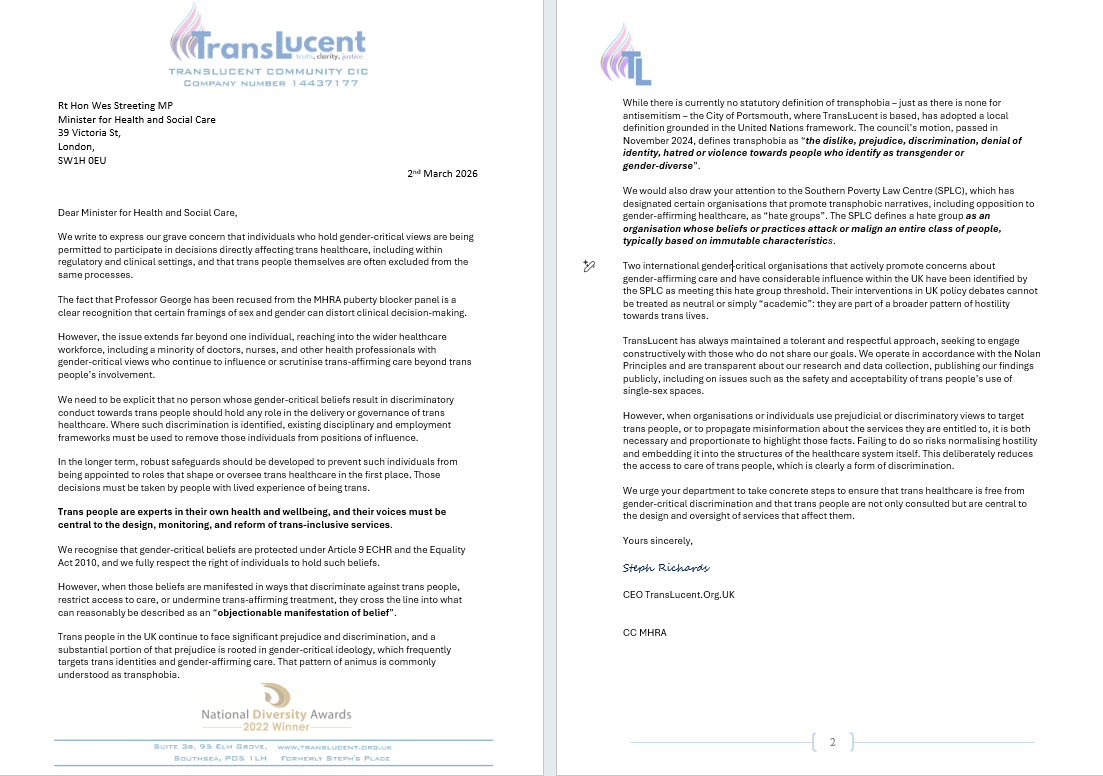
Our letter sent today to Rt Hon Wes Streeting MP in regards to gender-critical ideology affecting trans peoples healthcare.
Our letter sent today to Rt Hon Wes Streeting MP
Dear Minister for Health and Social Care,
We write to express our grave concern that individuals who hold gender‑critical views are being permitted to participate in decisions directly affecting trans healthcare, including within regulatory and clinical settings, and that trans people themselves are often excluded from the same processes.
The fact that Professor George has been recused from the MHRA puberty blocker panel is a clear recognition that certain framings of sex and gender can distort clinical decision‑making.
However, the issue extends far beyond one individual, reaching into the wider healthcare workforce, including a minority of doctors, nurses, and other health professionals with gender‑critical views who continue to influence or scrutinise trans‑affirming care beyond trans people’s involvement.
We need to be explicit that no person whose gender‑critical beliefs result in discriminatory conduct towards trans people should hold any role in the delivery or governance of trans healthcare. Where such discrimination is identified, existing disciplinary and employment frameworks must be used to remove those individuals from positions of influence.
In the longer term, robust safeguards should be developed to prevent such individuals from being appointed to roles that shape or oversee trans healthcare in the first place. Those decisions must be taken by people with lived experience of being trans.
Trans people are experts in their own health and wellbeing, and their voices must be central to the design, monitoring, and reform of trans‑inclusive services.
We recognise that gender‑critical beliefs are protected under Article 9 ECHR and the Equality Act 2010, and we fully respect the right of individuals to hold such beliefs.
However, when those beliefs are manifested in ways that discriminate against trans people, restrict access to care, or undermine trans‑affirming treatment, they cross the line into what can reasonably be described as an “objectionable manifestation of belief”.
Trans people in the UK continue to face significant prejudice and discrimination, and a substantial portion of that prejudice is rooted in gender‑critical ideology, which frequently targets trans identities and gender‑affirming care. That pattern of animus is commonly understood as transphobia.
While there is currently no statutory definition of transphobia – just as there is none for antisemitism – the City of Portsmouth, where TransLucent is based, has adopted a local definition grounded in the United Nations framework. The council’s motion, passed in November 2024, defines transphobia as “the dislike, prejudice, discrimination, denial of identity, hatred or violence towards people who identify as transgender or gender‑diverse”.
We would also draw your attention to the Southern Poverty Law Centre (SPLC), which has designated certain organisations that promote transphobic narratives, including opposition to gender‑affirming healthcare, as “hate groups”. The SPLC defines a hate group as an organisation whose beliefs or practices attack or malign an entire class of people, typically based on immutable characteristics.
Two international gender‑critical organisations that actively promote concerns about gender‑affirming care and have considerable influence within the UK have been identified by the SPLC as meeting this hate group threshold. Their interventions in UK policy debates cannot be treated as neutral or simply “academic”: they are part of a broader pattern of hostility towards trans lives.
TransLucent has always maintained a tolerant and respectful approach, seeking to engage constructively with those who do not share our goals. We operate in accordance with the Nolan Principles and are transparent about our research and data collection, publishing our findings publicly, including on issues such as the safety and acceptability of trans people’s use of single‑sex spaces.
However, when organisations or individuals use prejudicial or discriminatory views to target trans people, or to propagate misinformation about the services they are entitled to, it is both necessary and proportionate to highlight those facts. Failing to do so risks normalising hostility and embedding it into the structures of the healthcare system itself. This deliberately reduces the access to care of trans people, which is clearly a form of discrimination.
We urge your department to take concrete steps to ensure that trans healthcare is free from gender‑critical discrimination and that trans people are not only consulted but are central to the design and oversight of services that affect them.
Yours sincerely,
Steph Richards
CEO TransLucent.Org.UK
CC MHRA