








Summary
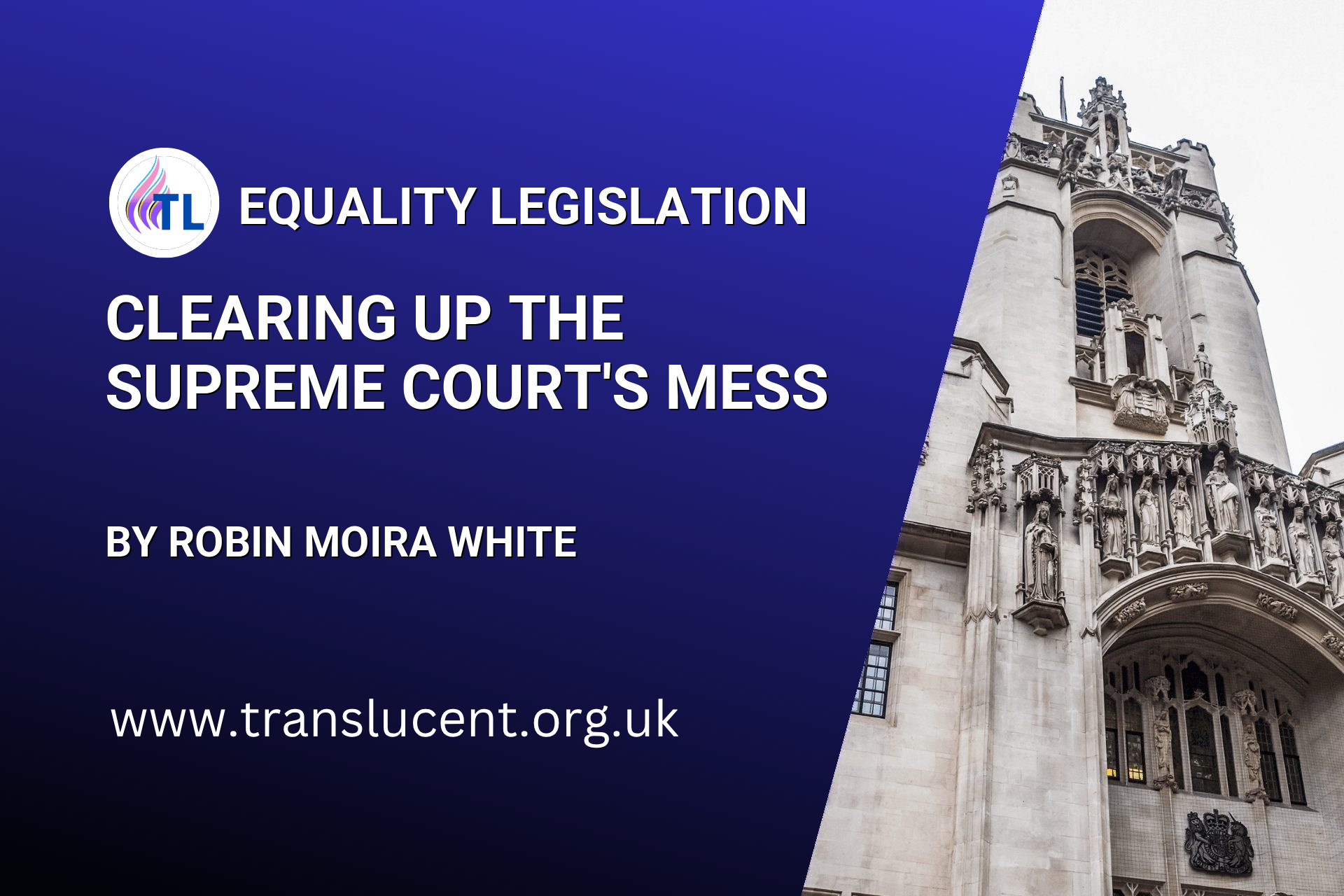
Clearing up the Supreme Court's Mess - an article authored by barrister Robin Moira White, explains how simple it would be for the government to rectify the judgment FWS v SGM which has, in consequence affected hundreds of thousands of cisgender and trans people's lives.
Clearing up the Supreme Court’s Mess
Opinion: by barrister Robin Moira White. This article was updated on 16/03/26 (as below).
It is remarkably easy for parliament to restore the will of parliament in passing the Equality Act 2010 and the Gender Recognition Act 2004, which were spectacularly misinterpreted by the UK Supreme Court in ‘For Women Scotland’.[1]
The Judgment
The Supreme Court decided, of course, that ‘sex’ wherever it appears in the Equality Act 2010, means ‘biological sex’ as recorded at birth. I have written previously about how bad a piece of jurisprudence this judgment was. This article is about how to put things right, so I will not focus on explaining the canards in the judgment but a brief summary may be helpful.
Despite referencing both the Goodwin ECtHR case[2] and the European Convention on Human Rights, there is no analysis in the judgment of the compatibility of the judgment with the Convention as required by the UK Human Rights Act. The judgment is internally inconsistent as the interpretation of ‘sex’ in the Act as ‘biological sex’ makes a nonsense of the definition of gender reassignment in section 7 and the sports provisions in section 195. The basis for the decision – that ‘sex’ must be consistent across the whole Act is not what the relevant legal authority says, rather that authority requires consistency of meaning within a section of an Act.
Gender-critical writers such as Michael Foran have praised the judgment, but I regularly receive correspondence from university law students and lecturers who cannot follow the decision’s logic. The interpretation is clearly contrary to the stated intention of parliament in enacting the two relevant statutes, which the Supreme Court also ignored.
The Effect of the Judgment
Allowing trans people to live effectively in their changed gender is the requirement of the European Convention on Convention states and was the purpose of the 2004 and 2010 Acts. The judgment has been increasingly used by those who do not support trans people living with such acceptance, despite there being no evidence of harm to cis-society in the years since the relevant provisions were enacted.
Politics
Trans people feel most abandoned by the Labour Party, for which the Equality Act 2010 was a crowning achievement. Statements by Sir Keir Starmer that the judgment had brought ‘welcome clarity’ and Harriet Harman that the interpretation met her intentions in enacting the legislation have caused many trans individuals and organisations to regard the current leadership as essentially transphobic. This seems consistent with the apparent Labour strategy to meet the right-wing populism challenge, led by ‘Reform’, by being ‘more Reform than Reform’. Sir Keir Starmer’s comment on immigration of being ‘a country of strangers’ supports this.
However, the rise of the Green Party, the popularity of their leader Zack Polanski, together with their stunning victory of Hannah Spencer in the Gordon and Denton byelection, show that support for trans people, amongst other social justice issues, is not an inherent vote-loser, no matter how strong the attack by right-wing media. Whether the departure of Morgan McSweeney as the Prime Minister’s Chief of Staff signals a return to social justice for Labour in time to rescue the Party’s dire position in the polls remains to be seen.
How could the intention of parliament in 2010 be restored?
It is really very simple.
Section 212 of the Equality Act sets out a series of definitions to be used in interpreting the Act. These include:
‘man’ means a male of any age.
And
‘woman’ means a female of any age.
These definitions were included because the Act deals not solely with adult affairs but matters such as education, services and sport, which affect children and young people. I know this to be correct, as I spoke with those drafting the Act while it was being prepared. But it has subsequently been suggested that these passages should be interpreted to exclude trans people.
Some complexity also remains, as trans men require maternity protections under the Act.
So how could the above definitions be extended to restore the will of parliament?
I would suggest:
‘man’ means a male of any age and (except for sections 72 to 76 ‘maternity and paternity’) includes a person with the protected characteristic of gender reassignment or a gender recognition certificate who identifies as male’.
And
‘woman’ means a female of any age and (except for sections 72 to 76 ‘maternity and paternity’) includes a person with the protected characteristic of gender reassignment or a gender recognition certificate who identifies as female’.
This would restore the position understood to exist during the drafting of the Act and its passage through parliament before the recent ruling, but would leave the derogations for the rare circumstances in which the exclusion of a trans person serves a real societal purpose.
I would be happy to discuss these suggestions with anyone who believes they can be improved.
Sir Keir, that is what true clarity looks like – and finding time in the legislative programme for such a small piece of legislation would go a very long way to restoring Britain’s support for equality and diversity.
Over to the courageous people who believe in social justice.
Robin Moira White
Clearing up the Supreme Court’s Mess
15 March 2026
ADDITIONAL NOTE:
Since writing this article only yesterday, I have been overwhelmed by myriad responses all saying, in different ways, ‘this is what we need’. Two practical suggestions have been made, which should be appended to my article to fully reverse the effect of the FWS Supreme Court judgment and restore the status quo ante.
The first is an amendment to the Workplace (Health, Safety and Welfare) Regulations 1992
(SI 1992/3004)
Section 2, the ‘interpretation’ section, would need a definition of ‘man’ and ‘woman’ consistent with that suggested for the Equality Act.
The second is an amendment to the Gender Recognition Act to make plain that the operation of section 9(3) of that Act should be explicitly stated in any Act which seeks to derogate from the effect of section 9(1) which provides that trans people should be recognised in their affirmed gender ‘for all purposes.
Section 9(3) presently says:
Subsection (1) is subject to provision made by this Act or any other enactment or subordinate legislation.
And could be amended to read:
Subsection (1) is subject to provision made by this Act or any other enactment or subordinate legislation which explicitly disapplies the provisions of this Act.
Robin Moira White
16.3.26
[1] For Women Scotland v Scottish Ministers [2025] UKSC 16
[2] Goodwin v UK ECtHR 28917/95 (11 July 2002)
Opinion: 15/3/26 Clearing up the Supreme Court’s Mess